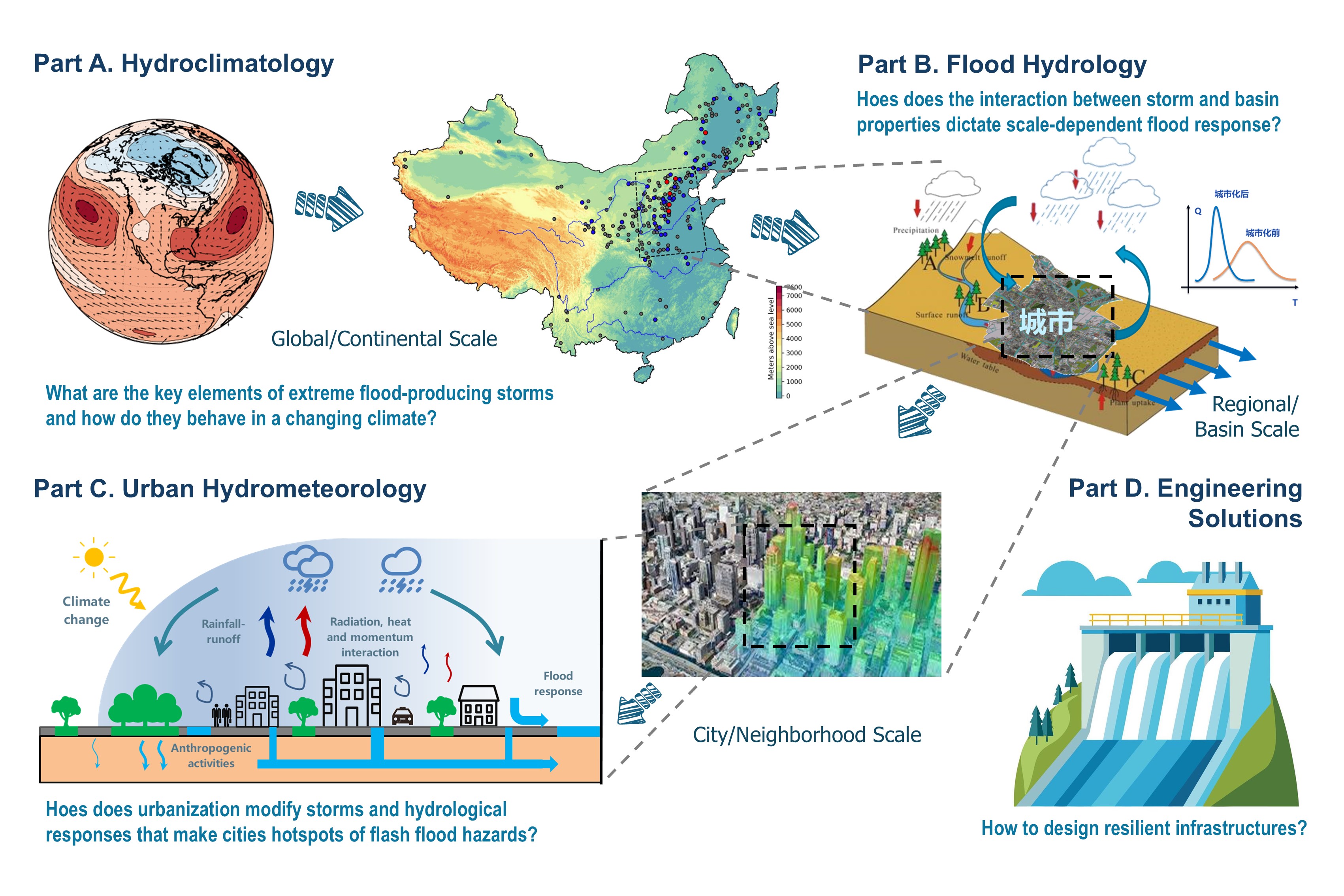
What are the key elements of extreme flood-producing storms?
How do these elements behave in a changing climate?
This research direction focuses on the mechanisms of flood generation at global and continental basin scales and their responses to climate change, with particular attention to key flood-producing rainfall factors and the spatiotemporal variability of basin properties.
Climate change
Hydroclimate
Hydrology and water resources
National Natural Science Foundation of China, Major Research Plan Integrated Project, Runoff changes and adaptive utilization in southwestern river source areas
National Natural Science Foundation of China, Sino-Swiss International Cooperation Project, Impact of climate change on hydrology and water resources in the Yangtze and Mekong river basins
Fundamental scientific research funds for central universities, international cooperation projects, basin flood teleconnection characteristics and formation mechanisms
How does the interaction between storm and basin properties dictate scale-dependent flood response?
This research direction focuses on hydrological processes of flood generation at regional and basin scales, especially how interactions between storm spatiotemporal characteristics and basin hydro-hydraulic properties shape scale-dependent flood responses.
Hydrological process
Heavy rain causing floods
Watershed function
Production confluence
National Natural Science Foundation of China, general project, research on the regional distribution patterns and formation mechanisms of extraordinary floods in my country
Frontier Science Center of the Ministry of Education, Science and Technology Leading Talent Team Project, Process Mechanism and Evolution of Hydrological Extreme Events in the East Asian Monsoon Region
Frontier Science Center of the Ministry of Education, GEO-X Key Project, Evolution Law and Mechanism of Flood Disasters in the Yangtze River Basin
Xinjiang Uygur Autonomous Region Natural Science Foundation, key project, study on century-scale water resource evolution and flood and drought disaster mechanism in Xinjiang
How does urbanization modify storms and hydrological responses that make cities hotspots of flash flood hazards?
This research direction focuses on hydrometeorological processes at urban and community scales, especially how urbanization alters storm structure and hydrological response, making cities hotspots of pluvial and flash-flood hazards.
Land-atmosphere interaction
Urbanization
Hydrological effects
National Natural Science Foundation of China, Youth Fund Project, Research on the Impact of Urban Complex Underlying Surfaces on Flooding and Heavy Rainfall
Jiangsu Provincial Natural Science Foundation, Outstanding Youth Fund Project, Mechanism and prediction of heavy rain and floods in Yangtze River Delta cities
Jiangsu Provincial Natural Science Foundation, Youth Fund Project, Research on the spatiotemporal distribution characteristics and nowcasting of urban flood-induced rainstorms
How to design resilient infrastructures for flood mitigation and adaptation?
This research direction focuses on designing resilient infrastructure systems to mitigate and adapt to increasingly severe water-hazard challenges.
Engineering hydrology
Design rainstorm
Design flood
Tibet Autonomous Region Science and Technology Plan, Key R&D Plan Project Topics, Research on the Impact of Hydropower Development on Water Vapor Transport in the Grand Canyon